
- Everything you need is included in the kit.
- Can run one sample at a time or batch up to 12 samples.
- Test for all three core vaccine diseases in one run
- No special training required

Confirm Core Vaccine
Immunity In-Clinic - Fast,
Reliable & Cost-Effective
Titer Test for Dogs and Cats
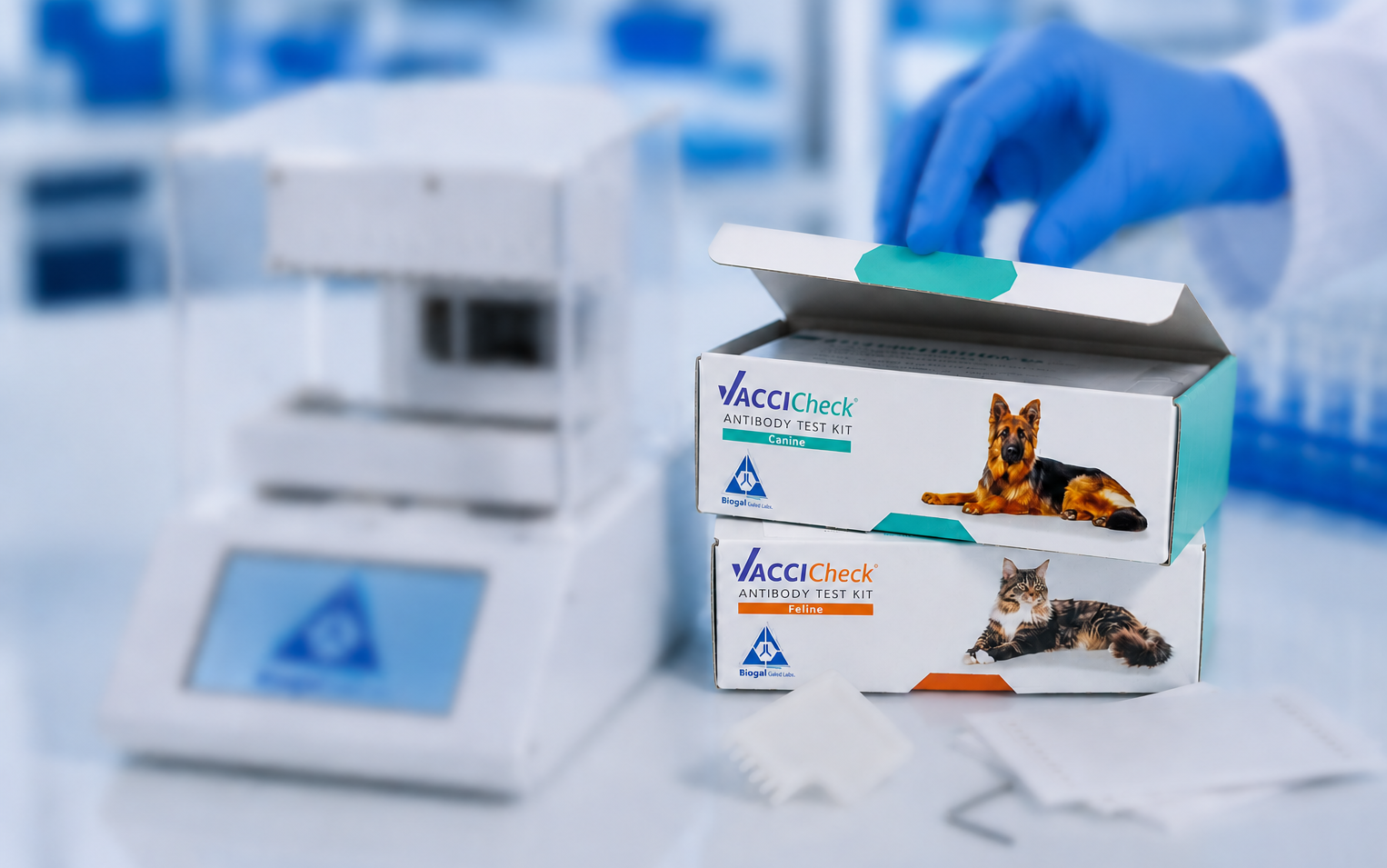
VacciCheck is an in-clinic, IgG antibody dot-ELISA-based system for confirmation of core vaccine immunity levels in dogs and cats. This semi-quantitative antibody titer test determines whether your patients are protected or need re-vaccination, helping you make evidence-based vaccination decisions.
 Dog: CDV, CAV, CPV
  Cat: FPV, FHV, FCV
Benefits
Portable and easy to use
In-Clinic, Same-Day Results
- Perform antibody titer testing directly in your clinic with
results in 23 minutes.
High Sensitivity & Specificity
- Lab-grade accuracy with performance validated against gold standard VN and HI assays.
Minimally Invasive
- Requires only a drop of blood (10μL whole blood or 5μL serum/plasma).
Cost-Effective and Client-Friendly
- Affordable. Lower cost than send-out options. Easy for clients to approve.
Evidence-Based Practice Enhancement
- Enables informed vaccine decisions and builds client trust.
Streamlined Automation Available
- Optional automated accessories (RoboComb+, CombCam, Plate Warmer) reduce hands-on time and eliminate subjective result interpretation for consistent, objective titer testing

Applications

Vaccine Response Confirmation
Verify puppies and kittens developed protective antibodies after their primary vaccine series.

Booster Vaccination Decisions
Use antibody testing to support data-driven booster vaccination decisions.

Unknown Vaccination History
Assess immunity in adopted or rescued animals with unknown vaccination records.

Outbreak Management
Identify protected and unprotected animals to help manage disease spread in shelters or boarding facilities.
Performance Data
Virus
Sample size
Sensitivity
Specificity
Gold Standard Method
Canine Adenovirus CAV
183
96%
90%
Virus Neutralization (VN)
Canine Parvovirus CPV
563
97%
94%
Hemagglutination Inhibition (HI)
Canine Distemper CDV
563
96%
88%
Virus Neutralization (VN)
Virus
Sample size
Sensitivity
Specificity
Gold Standard Method
Feline Calici Virus FCV
344
90%
91%
Virus Neutralization (VN)
Feline Herpesvirus FHV
344
93%
96%
Virus Neutralization (VN)
Panleukopenia Virus FPLV
344
89%
89%
Hemagglutination Inhibition (HI)
How to Use VacciCheck

Step
1
Collect Sample
Draw only 10 microliters of whole blood or 5 microliters of serum/plasma.

Step
2
Run the Test
Add the small blood sample to the test comb, follow the 6-step protocol through incubation wells, and develop results in 23 minutes.

Step
3
Read Results
Compare sample spot colors to the reference scale or use automated reading with CombCam for objective interpretation of titer levels.

Additional Equipment - Automate Your Process

RoboComb+ – Automated Operation
Automated incubation device designed specifically for VacciCheck
and ImmunoComb testing protocols.
and ImmunoComb testing protocols.
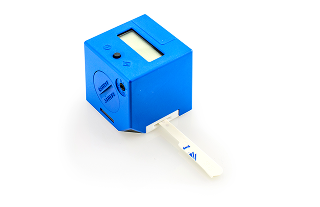
CombCam - Automated Reading
Objective digital interpretation of VacciCheck results eliminates subjective reading variations.

Plate Warmer - Streamlined Preparation
Reduces warming time for test plates, streamlining your testing workflow.
Literature

A point-of-care dot blot ELISA assay for detection of protective antibody against canine
adenovirus, canine parvovirus, and canine distemper virus is diagnostically accurate
adenovirus, canine parvovirus, and canine distemper virus is diagnostically accurate
Azizeh Egerer, BS; Zoie Schaefer, DVM; Laurie Larson, DVM* Companion Animal Vaccines and ImmunoDiagnostics
Service Laboratory, Department of Pathobiological Sciences, School of Veterinary Medicine, University of
Wisconsin–Madison, Madison, WI
Service Laboratory, Department of Pathobiological Sciences, School of Veterinary Medicine, University of
Wisconsin–Madison, Madison, WI
Antibody Testing VS Vaccination Applications in Clinical Practice
RICHARD B. FORD
PROFESSOR OF MEDICINE, DIPLOMATE ACVIM AND ACVPM (HON)
PROFESSOR OF MEDICINE, DIPLOMATE ACVIM AND ACVPM (HON)
Prevalence of Serum Antibody Titers against Core Vaccine Antigens in Italian Dogs
Paola Dall’Ara¹, Stefania Luzzi¹, Jari Zambarbieri¹, Francesco Servida², Laura Barbieri³,
Roberto Rosenthal⁴, Lauretta Turin¹⁰, Elena Scarparo¹, and Joel Filipe¹⁰
Roberto Rosenthal⁴, Lauretta Turin¹⁰, Elena Scarparo¹, and Joel Filipe¹⁰
Long-lived immunity to canine core vaccine antigens in UK dogs as assessed by an in-practice test kit
R. Killey¹, C. Mynors², R. Pearce³, A. Neil³, A. Prentis³, and M. J. Day⁴
¹ Moreton Morrell College, Moreton Morrell, Warwickshire, CV35 9BL, UK
² Medivet, Watford, Hertfordshire, WD24 7UY, UK
³ Hyde Park Veterinary Centre, London, W2 2AE, UK
⁴ School of Veterinary Sciences, University of Bristol, Langford, North Somerset, BS40 5DU, UK
¹ Moreton Morrell College, Moreton Morrell, Warwickshire, CV35 9BL, UK
² Medivet, Watford, Hertfordshire, WD24 7UY, UK
³ Hyde Park Veterinary Centre, London, W2 2AE, UK
⁴ School of Veterinary Sciences, University of Bristol, Langford, North Somerset, BS40 5DU, UK
Effect of Aging on the Immune Response to Core Vaccines in Senior and Geriatric Dogs
Paola Dall’Ara¹, Stefania Luzzi¹, Lauretta Turin¹, Giulia Castaldelli¹, Francesco Servida², and Joel Filipe¹
Contact us
FAQ
1.What is VacciCheck?
VacciCheck is an in-clinic IgG antibody titer test that evaluates immunity to the core vaccine diseases in dogs and cats by measuring specific antibody levels. It helps veterinarians confirm a pet’s immune status and support evidence-based vaccination decisions.
2.What does VacciCheck test for?
For dogs it measures antibodies against distemper, parvovirus, and adenovirus. For cats it measures antibodies against panleukopenia, feline herpesvirus, and calicivirus. (*herpesvirus and calicivirus not available in selected countries)
3.How is VacciCheck different from sending samples to a lab?
VacciCheck delivers fast, in-clinic results, in 23 minutes, so clinicians don’t have to send blood out for testing.
4.How do I interpret VacciCheck results?
After the test develops, gray dots appear on the comb. A score of 3 or higher (relative to the positive control) generally indicates protective immunity.
5.Can VacciCheck results be given a numerical value?
Yes. VacciCheck provides semi-quantitative results using a slide scale that matches the intensity of the dots to a corresponding number.
6.Does VacciCheck test for rabies immunity?
No. VacciCheck does not test for rabies antibody titers; those are handled differently due to regulatory requirements and guidelines.
7.Can puppies and kittens be tested with VacciCheck?
Yes. It’s recommended to test puppies/kittens about 4 weeks after completing their initial core vaccine series to confirm that protective immunity has developed.
8.How can VacciCheck be used in shelters?
VacciCheck helps manage disease outbreaks in shelters by identifying which animals are protected and which need quarantine or vaccination, supporting safer and faster decision-making.
9.How much sample is needed?
The test requires only 5 µL of serum or plasma or 10 µL of whole blood.
10.Is any special equipment needed to run the test?
No. VacciCheck is designed as a complete in-clinic kit. Optional tools like the Platewarmer, RoboComb+, and CombCam can help speed up the workflow or automate reading but are not required.
11.How should VacciCheck kits be stored?
Kits should be kept refrigerated at 2–8 °C (35–46 °F) when not in use, and brought to room temperature before testing.
12.How should samples be stored before testing?
Fresh whole blood should be refrigerated if used within a day. Serum/plasma can be refrigerated for up to three days or frozen for longer storage. Bring to room temperature before testing.
13.What is the shelf life of VacciCheck?
VacciCheck kits have a shelf life of 15 months from production. Expired kits should not be used.
14.Can I run multiple tests at once?
Yes. You can run up to 12 samples simultaneously, and unopened portions of the kit remain stable for use later.
15.Is VacciCheck scientifically validated?
Yes. VacciCheck has been validated against gold-standard lab methods (virus neutralization and hemagglutination inhibition) and approved by veterinarians and regulatory authorities like the USDA (USA), CFIA (Canada), and MAFF (Japan).
16.Can pet owners run the test themselves?
No. Titer testing requires blood collection and interpretation by a veterinarian or trained veterinary staff, and clinical context should guide decision-making.